
Why Your Starter Locs Are Bunching (And What That Actually Means)
Bunching during the starter loc phase is one of the most misunderstood parts of the loc journey.
It’s often labeled as “ugly,” “wrong,” or something that needs to be fixed immediately.
But before you try to correct it, you need to understand what’s actually happening.
Because bunching is not random.
It’s structural.
What’s Happening Inside the Hair

Afro-textured hair is highly responsive to water.
When water enters the strand, it penetrates into the cortex and disrupts temporary hydrogen bonds.
That causes the hair to return to its natural coiled state almost immediately.
This is why:
-
stretched hair shrinks when wet
-
blow-dried hair contracts
-
and elongated styles don’t hold without tension
This reaction is not damage.
It’s normal behavior.
In the starter loc phase, that same process is happening—but now the hair is being trained into a structure.
Why Bunching Happens in Starter Locs
When you start locs using methods like:
-
two-strand twists
-
braids
-
or even coils
you are dividing the hair into sections that do not all behave the same way.
Each strand within that section absorbs water at a different rate.
So what happens?
Some parts of the loc shrink faster than others.
That uneven contraction causes the hair to:
-
fold inward
-
gather in certain areas
-
and create what looks like bunching or stacking along the shaft
This is especially common in the early phase when the hair is still soft and not fully matted.
Bunching vs. Budding (They Are Not the Same)
This is where a lot of confusion happens.
Budding is internal.
Bunching is external.
-
Budding = compacted hair forming inside the loc (this is part of maturation)
-
Bunching = hair folding or clumping unevenly along the outside of the strand
Bunching is usually the result of:
-
uneven shrinkage
-
slippage in softer sections
-
inconsistent maintenance
-
or buildup interfering with the strand behavior
Understanding the difference matters.
Because one is part of the process.
The other needs management.
Why You Shouldn’t Ignore It
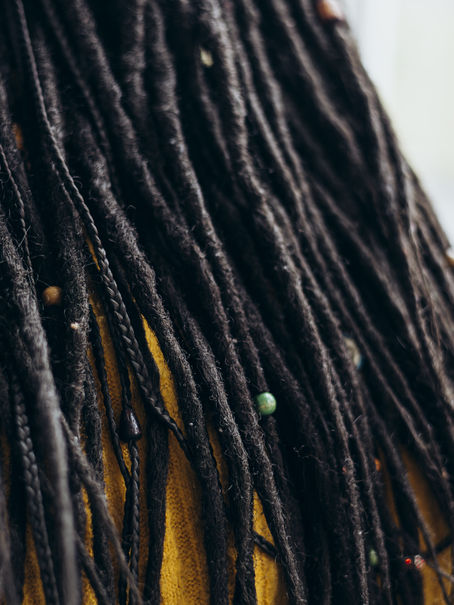
If bunching is left without correction, it can lock into that shape.
That’s when you start seeing:
-
loops of loose hair sticking out
-
uneven density along the loc
-
soft pockets that never fully compact
Over time, this can lead to:
-
weak points in the loc
-
inconsistent thickness
-
or a “bubbled” appearance that’s difficult to correct later
Once that structure sets, you’re no longer guiding the loc.
You’re repairing it.
Where Cultivation Comes In
This is the part most people skip.
Locs do not form evenly without guidance.
They have to be cultivated.
That means:
-
manually pulling the loc downward to counteract shrinkage
-
separating and freeing snagged hairs
-
smoothing the shaft before the hair mats into place
This should be done gently and consistently.
Not aggressively.
Because over-manipulation can create its own issues:
-
tension at weak points
-
breakage
-
or thinning over time
The Problem With Over-Correcting
A lot of people try to fix bunching using tools too early.
Crochet tools, in particular, are often misused.
Yes, they can:
-
pull loose hairs into the loc
-
tighten structure
-
and smooth the appearance
But when used incorrectly, they can:
-
create large bubbles
-
compress the hair unevenly
-
and damage the internal structure of the loc
That’s why crochet should be:
-
controlled
-
minimal
-
and used with intention—not as a quick fix
Other Factors You Might Be Overlooking
There are a few additional causes of bunching that often get missed:
Product Buildup
Heavy products coat the strand and block water from entering evenly.
This disrupts how the hair shrinks and mats, leading to irregular formation. You can read more about product buildup and removal check out “Stop The Buildup” article.
Improper Washing Technique
Rough washing or not securing the hair can cause sections to shift and tangle.
This leads to:
-
merging
-
clumping
-
and bunching during drying
Read “The Crown Care System” to learn proper shampoo techniques.
Inconsistent Maintenance
If the root is maintained but the shaft is ignored, the loc forms unevenly.
That creates:
• soft areas
• dense areas
• and structural imbalance
Hair Texture & Density Differences
Not all areas of the head behave the same.
The crown, nape, and edges may:
-
shrink differently
-
lock at different speeds
-
and require different levels of attention

How to Reduce and Prevent Bunching
You don’t stop bunching completely.
You manage it.
That includes:
-
keeping the hair clean so water can move freely
-
avoiding heavy products that interfere with the strand
-
maintaining a consistent schedule
-
gently stretching and guiding the loc as it forms
-
protecting the hair during washing (braid and band if needed)
Final Thought
Bunching is not a failure in your loc journey.
It’s feedback.
It’s showing you:
-
how your hair responds to water
-
how your structure is forming
-
and where your maintenance needs adjustment
Locs are not just installed.
They are developed.
If you’re unsure whether what you’re seeing is normal budding or problematic bunching, start with a proper assessment.
Because the earlier you understand the structure, the easier it is to guide the outcome.
Respect the biology. Then enhance the beauty.
Leave a Reply